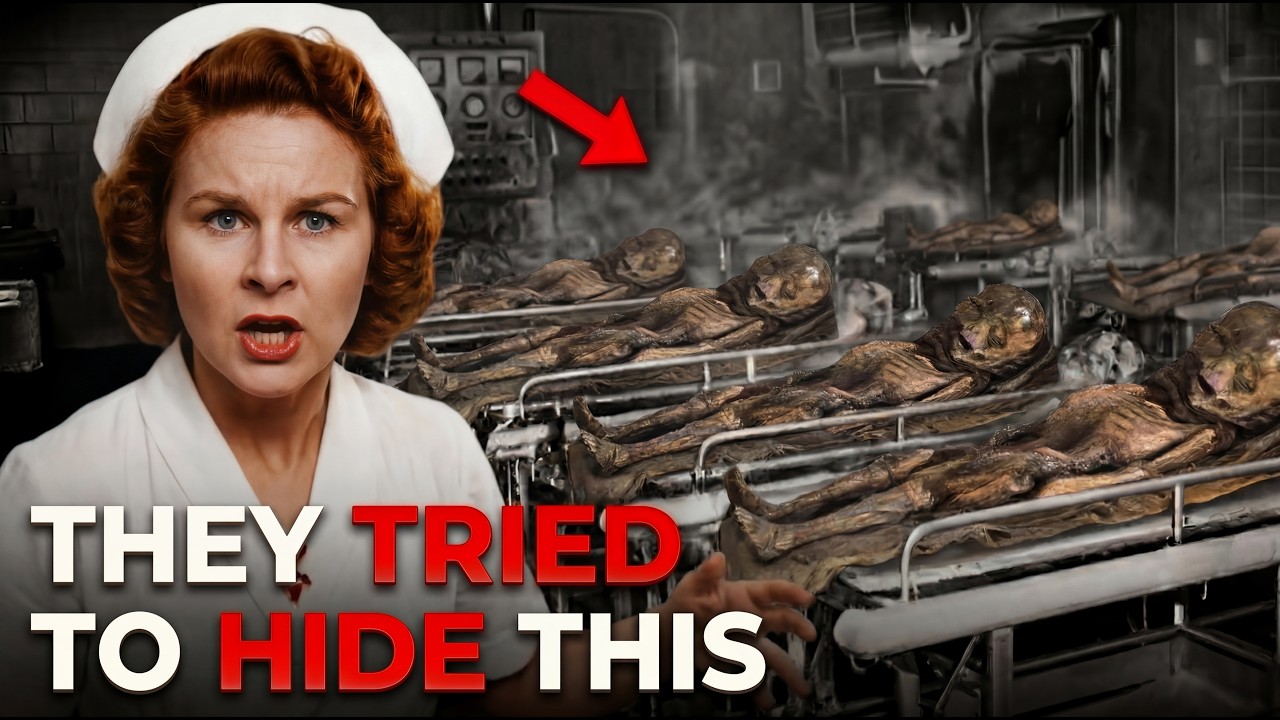
The Roswell nurse story is unusually easy to test, because it comes with a name. A nurse said to have worked at the base hospital in July 1947, said to have described small bodies to a local mortician, and said to have been transferred abroad and killed in a crash shortly afterwards. Army Nurse Corps records for that period are complete. There is nobody in them by that name.
The short version
- The account came from a Roswell funeral director who first told it publicly in 1989, forty-two years after the events.
- The nurse he named cannot be found in nursing corps rosters, base records, census data or transfer orders.
- Several prominent researchers who originally promoted the testimony later withdrew their support because of that failure.
- The debris itself has a documented and genuinely classified explanation: a balloon-borne acoustic system for detecting Soviet nuclear tests.
The shape of the story
The mortician said he received a call from the base asking about small hermetically sealed caskets, that he drove out on unrelated business, that he was ejected from the hospital by military police, and that a young nurse he knew took him aside and sketched what she had seen: small bodies with oversized heads and unusual eye sockets. He said she was posted to England within days and died in an aircraft accident. He gave her name.
That last detail is what makes the case worth taking seriously rather than dismissing, because it is checkable. A serving nurse in 1947 leaves a long trail: a commission, a service number, pay records, station assignments, transfer orders, a casualty file if she died on active duty, a next of kin, a grave, a hometown newspaper obituary. All of that is searchable, and much of it is public.
What the search returned
Nothing. No commission, no service number, no roster entry, no transfer, no casualty record, no obituary, no family. Researchers looked not only for the exact name but for near matches and variant spellings, and checked the nurses who were actually stationed at the base, whose names are known. None of them fits the description, and none of them died in the manner claimed.
The significant part is who did the looking. This was not debunkers working from the outside. Investigators who had spent years arguing that something unexplained happened at Roswell ran these checks themselves, published the negative results, and publicly withdrew their reliance on the testimony. That is exactly how it should work, and it is a point in the field's favour rather than against it.
| Detail | Status |
|---|---|
| Debris recovered on a ranch near Roswell | July 1947, documented |
| Army press release announcing a captured disc | 8 July 1947, retracted the same day |
| Public interest in the case | Essentially dormant from 1947 until 1978 |
| Mortician's account first told publicly | 1989 |
| Nurse's name in nursing corps records | No match found |
| Official explanation for the debris | A classified balloon-borne acoustic programme |
| Purpose of that programme | Detecting Soviet nuclear tests from a distance |
| Key witnesses later shown to have used forged documents | At least one |
The thirty-one-year gap
Roswell's most underrated fact is that for three decades nothing happened. The debris was reported in July 1947, explained away as a weather balloon the same day, and then vanished from public discussion almost entirely until an interview in 1978 with the intelligence officer who had handled the material. A book followed in 1980, and the case became famous.
Every account of bodies emerged after that point. This matters enormously for how the testimony should be weighted. By the time most witnesses spoke, they had lived through decades of films, paperbacks, documentaries and conversations about what Roswell supposedly was. Memory research is consistent and unkind here: recollections absorb material from later exposure, confidence rises as accuracy falls, and people become genuinely unable to distinguish what they saw from what they were subsequently told. A sincere witness in 1989 is not a reliable witness about 1947.
The field also suffered from outright fabrication. At least one celebrated Roswell witness was found, after his death, to have manufactured official-looking documents to support his account. That discovery poisoned a great deal of testimony that had been cross-referenced against his.
What genuinely happened
- Unusual debris was recovered and the Army briefly announced a captured disc.
- The published explanation was false, because the real programme was classified.
- Administrative records for the base covering that period were destroyed.
- Something at Roswell was deliberately concealed for decades.
What does not hold up
- The named nurse, who has no trace in any record.
- The bodies, all reported four decades or more after the fact.
- The autopsy film, later acknowledged as a reconstruction.
- Testimony chains anchored to a witness who forged documents.
The cover-up was real, just not that one
It is worth being blunt: the United States Army lied about Roswell in 1947. The weather balloon story was a cover. But the thing being covered was a secret effort to detect Soviet atomic tests by listening for their shockwaves in a stable layer of the upper atmosphere, using long trains of balloons carrying microphones and radar reflectors. The reflectors were built from balsa struts, foil-backed paper and tape, and one batch of tape was printed with decorative motifs by a toy manufacturer.
Read the eyewitness descriptions again with that in mind. Light beams that would not burn, foil that would not stay creased, and strange purple symbols along the struts. The details witnesses found most inexplicable are precisely the ones the classified hardware accounts for. In 1947 an intelligence officer holding that material genuinely could not identify it, and the people who could were not allowed to say.
That is a better story than a nurse who never existed. A nuclear-armed superpower could not tell a rancher what had landed in his field, because admitting it would have told Moscow how the United States planned to catch it testing a bomb.
The verdict
There was no nurse, and there are no autopsies. There was a real classified programme, a real official lie, a real thirty-one-year silence, and then a wave of testimony shaped by everything that had been published in the meantime. The Roswell case is a superb illustration of why a single checkable name is worth more than a hundred vivid recollections, and of what happens when someone finally checks.
About the author
Motech researches and produces long-form video on technology and the unexplained for an audience of more than 270,000 subscribers. Corrections and tips: info@richardelhaj.media