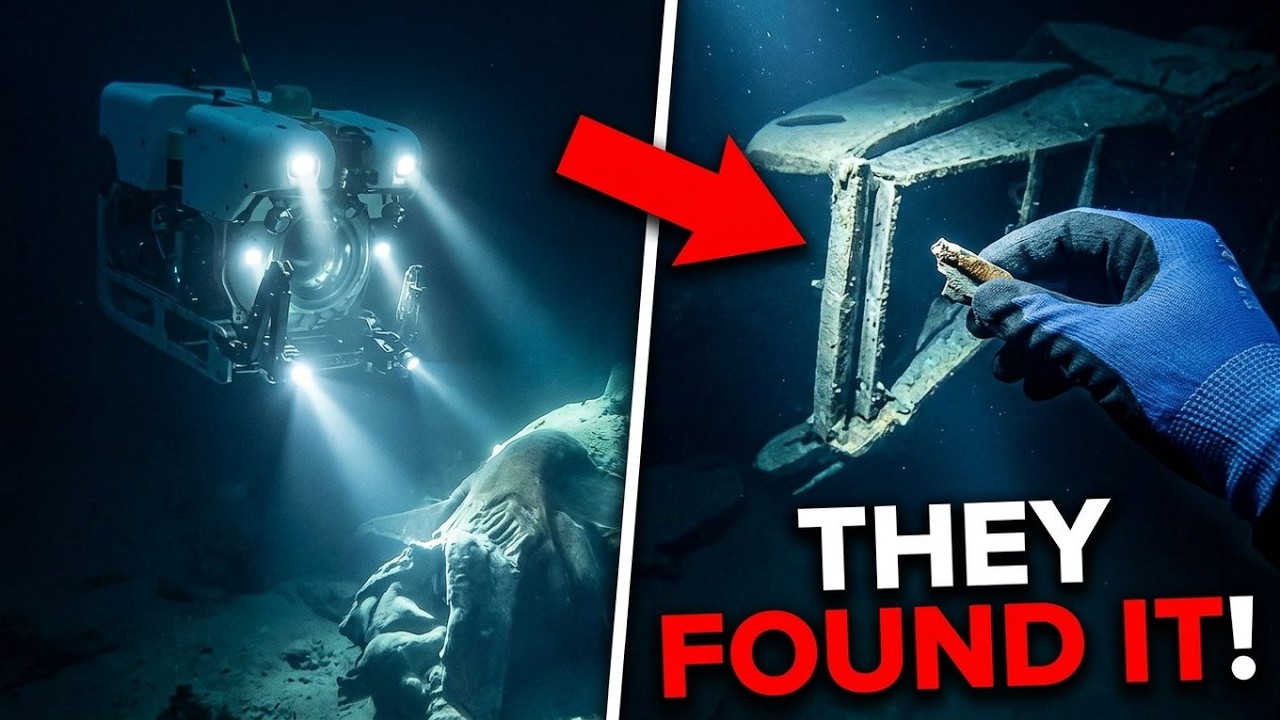
At the deepest surveyed point on Earth the water presses down with roughly a thousand times the force it does at the surface, enough to crush a sealed steel drum instantly. Robots have been going there for thirty years, and the strangest thing they have brought back is not a creature. It is a plastic bag.
The short version
- Challenger Deep sits close to 10,900 metres down, deeper than Everest is tall.
- Life there is abundant but strange: giant single-celled organisms, armoured scavengers, and fish that stop at a hard physiological limit.
- The most repeatable finding of the last decade is contamination, not monsters.
Getting there is still the hard part
The Mariana Trench is a subduction scar in the western Pacific, and Challenger Deep is its lowest measured basin. Only a handful of vehicles have reached the floor. The bathyscaphe Trieste carried Jacques Piccard and Don Walsh down in 1960 and stayed a few minutes. Japan's remotely operated Kaiko surveyed it in the mid-1990s and was later lost at sea. James Cameron's Deepsea Challenger made a solo descent in 2012. From 2019 onwards a titanium-hulled submersible built for repeat dives turned the trip from an expedition into something closer to a schedule.
Everything about the engineering is dictated by one number. Pressure at that depth is somewhere near 1,100 atmospheres. Syntactic foam gets compressed, viewports have to be thick cones of acrylic, and every penetration through the hull is a potential failure that would happen faster than a human could perceive it.
What is actually living down there
The trench floor is not barren. Cameras and baited landers reliably record amphipods, small shrimp-like scavengers that arrive within minutes of any food landing on the sediment. One hadal species has been found to line its exoskeleton with an aluminium-rich gel it appears to manufacture from seafloor minerals, which stops the shell dissolving in water chemistry hostile to calcium carbonate.
Alongside them are xenophyophores: single-celled organisms that grow to the size of a fist and build fragile structures out of sediment. There are sea cucumbers, polychaete worms, microbial mats around serpentinite mud volcanoes on the trench flank, and bacterial communities living off chemistry rather than sunlight.
The fish barrier
Fish are the exception, and the reason is elegant. Deep-sea fish stabilise their proteins with an osmolyte called TMAO, and the amount they need rises with depth. Somewhere around 8,200 metres the required concentration would make their tissues chemically unworkable. Hadal snailfish have been filmed and collected in the trench system at roughly eight kilometres down, and below that boundary the vertebrates simply stop. It is one of the few hard limits on life anyone has managed to predict and then confirm.
| Depth | What the vehicles record |
|---|---|
| 4,000 to 6,000 m | Abyssal plain fauna, grenadiers, sea cucumbers, manganese nodules |
| 6,000 to 8,000 m | Hadal snailfish, dense amphipod swarms, xenophyophores |
| 8,200 m and below | No fish. Invertebrates and microbes only |
| Near 10,900 m | Amphipods, bacterial mats, and human debris |
The finding that should have been the headline
A Japanese database of deep-sea debris footage recorded a plastic bag at close to 10,900 metres, which is as deep as anyone has looked. Worse, when researchers analysed amphipods collected from the Mariana and Kermadec trenches they found persistent organic pollutants, including PCBs, at concentrations comparable to some of the most industrialised coastal sediment on the planet. The mechanism is grimly simple. Contaminated material sinks, trenches act as sediment traps, and there is nowhere further down for any of it to go.
What robots do well
- Stay down for days, which humans cannot.
- Carry baited cameras and sampling gear cheaply.
- Return the same site repeatedly for real time series data.
Where they still fall short
- Tethers and comms are the usual point of failure.
- Samples decompress on the way up, damaging soft tissue.
- Coverage is tiny. Most of the trench has never been imaged.
Why so little of it has been seen
The hadal zone, everything below six kilometres, makes up only a small fraction of the seafloor but includes the least surveyed environment on the planet. High-resolution mapping of Challenger Deep covers a fraction of a percent of the trench system. Every serious expedition has come back with species that were not previously described, which tells you less about how exotic the place is and more about how thin the sampling remains.
What would move the field forward
Pressure-retaining sample chambers so animals arrive at the surface still at depth conditions, cheap expendable landers deployed in numbers rather than singly, and standardised contamination protocols so results from different trenches can actually be compared. None of that is glamorous, and all of it would tell us more than another record-setting descent.
Watch next on the channel
Related investigations. No affiliate links in this article.
- What they captured in the Puerto Rico Trench - the Atlantic's deepest point.
Watch on YouTube - Divers at the bottom of the Pacific - what pressure does to everything.
Watch on YouTube
The verdict
The trench is not hiding a monster. It is hiding an ecosystem that runs on scraps, survives chemistry that should dissolve it, and has already been reached by our rubbish. That is a better story than a sea serpent, and it is the one the robots keep confirming every time they go back down.
About the author
Motech researches and produces long-form video on technology and the unexplained for an audience of more than 270,000 subscribers. Corrections and tips: info@richardelhaj.media